Less Praise, More Trust: What Tokyo Is Teaching American Expat Parents About Getting Out of the Way
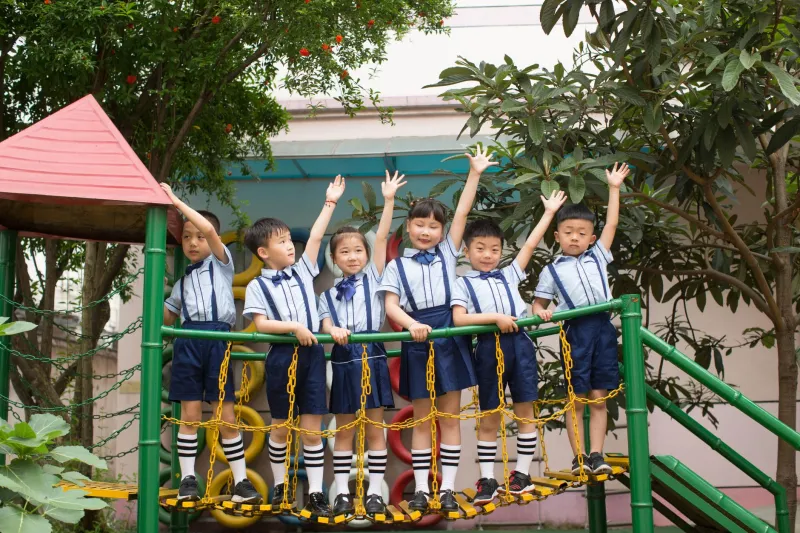
The moment that changed things for Sara Hendricks happened at a playground in Hiroo.
Her seven-year-old, Eli, had climbed to the top of a structure that Sara — raised in suburban Connecticut, trained by years of American parenting culture — would have previously described as "too high." In her old life, she would have been standing two feet away, hands raised, narrating the whole thing. You've got it, buddy. Almost there. I'm right here. So good, Eli, so good.
But the Japanese mothers around her weren't doing that. They were sitting on benches, talking to each other, glancing over occasionally with an expression that conveyed something between calm attention and complete trust. Their kids were climbing the same structure. Nobody was spotting anyone.
Sara sat down. She watched. Eli made it to the top, looked around, and climbed back down. He didn't look for her approval. He just went and found something else to do.
"I realized," she says, "that my constant narration wasn't for him. It was for me."
The American Praise Machine
American parenting, particularly in educated, middle-class households, has spent the last few decades building a fairly elaborate architecture of verbal encouragement. Gold stars. Specific praise. Growth mindset affirmations. The word "amazing" deployed so frequently it has lost all meaning. Every drawing is a masterpiece. Every mediocre soccer game is a triumph of effort.
The intention behind all of it is genuinely good. The research that inspired it — work on intrinsic motivation, on the power of process praise over outcome praise — is real. But somewhere between the research and the implementation, a lot of American parents ended up in a mode that functions less like encouragement and more like constant supervision of a child's emotional state.
Tokyo, for the expat parents paying attention, offers a different model.
"Japanese parenting isn't cold," says Marcus Webb, a former high school teacher from Portland who moved to Tokyo with his wife and two kids three years ago. "It's just less verbal. There's a lot of trust communicated through action. Through presence. Through letting kids handle things."
Marcus describes watching his nine-year-old daughter, Cleo, navigate a disagreement with a classmate at her local Japanese school without any adult intervention. The teacher observed. The kids worked it out. There was no mediation, no processing circle, no adult translating the emotional dynamics back to the children in real time.
"Cleo figured it out," he says. "And she was proud of herself in a way that had nothing to do with anyone telling her she'd done well. She just knew."
What "Letting Them Fail" Actually Looks Like
One of the most discussed aspects of Japanese early childhood education is the practice of soji — the daily cleaning of the school by the students themselves. No janitors. Kids sweep, mop, wipe down surfaces, and take responsibility for their shared environment as a matter of routine. It's unglamorous. Some kids do it badly at first. Nobody gets a prize for doing it well.
For American expat parents, soji tends to function as a kind of gateway concept — an entry point into a broader philosophy that treats competence as something developed through doing, not through being told you're capable of doing.
"My son had to clean the bathroom at his school," says Jennifer Nakamura, a remote data analyst from Chicago who has two kids enrolled in a local Minato-ku elementary school. "I braced for him to hate it. He came home and told me, completely matter-of-factly, that he'd gotten really good at scrubbing the tiles. He wasn't asking for praise. He was just reporting a fact about himself."
Jennifer has tried to bring that energy home. Less verbal processing of every experience. More room for her kids to arrive at their own conclusions. Fewer questions like How did that make you feel? and more simple, present attention.
"It's harder than it sounds," she admits. "I have to actively stop myself from filling the silence."
The Grandparent Problem
None of this happens in a vacuum, and the expat parents navigating this shift are quick to acknowledge the friction it creates — particularly with family back in the US.
Sara's mother, a retired kindergarten teacher from Connecticut, visited for two weeks last spring. The tension was immediate. Eli, now operating under a significantly less supervised parenting approach, wandered ahead on a walk, negotiated his own food order at a restaurant, and spent an afternoon building something in his room without anyone checking in on him for two hours.
"My mom kept asking if he was okay," Sara says. "I kept saying yes. By day four she pulled me aside and told me she was worried I'd become 'detached.' That word hit hard."
This is the central tension for American expat parents who've shifted their approach: the new philosophy makes intuitive sense in context, but it can look, from the outside, like neglect. American parenting culture has a strong social surveillance component — parents are judged, often harshly, for not being visibly engaged enough. The Japanese approach, which communicates care through a kind of steady, trusting background presence, doesn't translate easily into a FaceTime call with worried grandparents.
"I've had to do a lot of explaining," says Marcus. "And honestly, some of it lands and some of it doesn't. My dad still thinks I'm raising my kids to be emotionally unavailable. I think I'm raising them to be self-sufficient. We're probably both a little right."
The Re-Entry Question
The harder question — the one that doesn't have a clean answer yet — is what happens when these kids go back.
US schools are built on a particular set of social and academic expectations. Verbal participation is rewarded. Self-advocacy is expected. Kids who've been raised to operate with more independence and less constant affirmation may find themselves in classrooms that feel, as one parent put it, "relentlessly monitored."
Or they may find that the self-possession they developed in Tokyo turns out to be exactly the thing that helps them navigate American social dynamics more confidently.
Jennifer is betting on the latter. Her older son returned to the US for a year when her work required a temporary relocation, and she watched him move through his American middle school with a composure that surprised her.
"He didn't need the room to like him," she says. "He was just himself. That's not common at twelve. I don't think we gave that to him. I think Tokyo did."
Sara is less certain, and she's okay with that. She watches Eli at the playground — climbing things, failing at things, occasionally scraping a knee and looking at it with more curiosity than distress — and she thinks about the mother she was two years ago, standing with her hands raised, narrating everything.
"I don't know if I'm doing it right," she says. "But I'm pretty sure I was doing it wrong before."