Standing in Line for Ramen Taught These Americans Everything They Needed to Know About Love
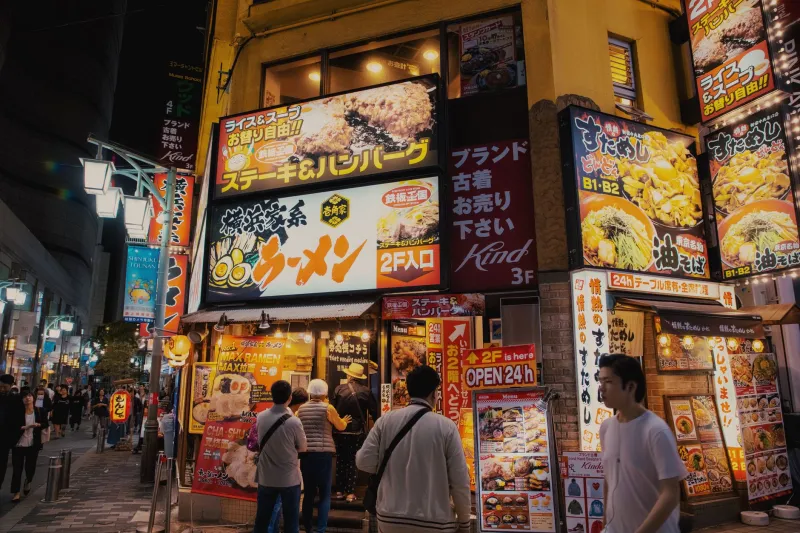
The line outside Fuunji in Shinjuku doesn't care about your schedule. It doesn't care that you have a 2 p.m. call or that your feet hurt or that you could, technically, be eating a perfectly adequate bowl of noodles somewhere else in under seven minutes. You stand. You wait. You do not check your phone obsessively. And when you finally sit down, lower your head over that bowl of tsukemen, and take the first sip — you understand, on some cellular level, why you waited.
Americans who move to Tokyo talk about this moment a lot. Not always about Fuunji specifically, but about the experience of waiting for something genuinely worth waiting for — and what that does to your sense of what's worth your time at all.
For a growing number of expats, the lesson traveled well beyond the dining table.
The Queue as Philosophy
Food culture in Tokyo is, among other things, a masterclass in delayed gratification. The city's best ramen shops, sushi counters, and kissaten don't advertise on aggregator apps. They don't offer reservations. They don't try to make the wait comfortable enough that you stop noticing it. The line is part of the experience — a filter that separates people who actually want to be there from people who just want to eat quickly and leave.
Americans, particularly those arriving from major cities where time is treated like a finite and constantly depleting resource, find this disorienting at first. Then they find it clarifying.
"I used to think waiting was a failure of logistics," says Marcus Webb, a 31-year-old UX designer from Austin who moved to Tokyo two years ago. "Like, if you're waiting, something went wrong. Someone didn't plan well enough. Tokyo completely dismantled that for me. Here, the wait is the signal. If people are lining up, it's because the thing at the end is worth it."
This reframe — from waiting as inconvenience to waiting as curation — turns out to have a surprisingly long reach.
When Food Standards Become Dating Standards
It would be a stretch to say that standing in line for noodles directly causes someone to approach romance differently. But expats describe something more gradual and more real: a cumulative shift in their tolerance for things that aren't quite right.
Tokyo's food culture is uncompromising in a specific way. The best spots don't hedge. They do one thing, they do it with obsessive precision, and they don't apologize for the inconvenience that obsession creates for the customer. There's a clarity to it that Americans find almost shocking — and then, quietly, start craving in other areas of their lives.
"I went on a date with a guy who talked about himself for two hours straight," says Jenna Park, a 29-year-old marketing consultant from New York who's been in Tokyo for eighteen months. "And I remember sitting there thinking: I just waited forty-five minutes for a bowl of soup that was perfect. Why am I sitting here for something that isn't?" She left before dessert. "Best decision I made all month."
This isn't a universal experience, and it's worth noting that Tokyo's dating scene has its own complications — language barriers, cultural differences around directness, expat community dynamics that can feel claustrophobic. But the theme emerges consistently: Americans who've absorbed Tokyo's food culture start applying its logic to romantic choices. Quality over convenience. Patience for the right thing, zero patience for the wrong one.
Swiping Left on the Scroll
The shift also shows up in how expats in Tokyo relate to dating apps — which is to say, many of them stop relating to them much at all.
Hinge, Tinder, Bumble — the American swipe-and-match infrastructure travels to Tokyo, technically. But something about the city makes it feel slightly absurd. The apps are built around volume and speed, a logic that runs directly counter to what Tokyo's best experiences keep teaching: that more options aren't the same as better options, and that the friction is often the point.
"The apps are basically the fast food version of dating," says Webb. "And once you've had the real thing — once you've waited for something that actually delivers — fast food stops being satisfying."
What replaces it, for many, is slower and harder to systematize. Connections that develop through shared environments — language classes, neighborhood spots, the small ecosystems that form around a particularly good jazz bar or a Sunday market. These aren't efficient. They don't offer the illusion of infinite options. But they tend to produce relationships with more actual foundation.
Patience as a Skill You Have to Practice
There's a practical component to this that gets underplayed in the more philosophical accounts. Patience, it turns out, is not a fixed personality trait. It's something you build or erode depending on your environment.
American consumer culture — and American dating culture, which has largely been colonized by consumer logic — is relentlessly optimized for the elimination of waiting. Same-day delivery. Instant matches. Skip-the-line passes. The message, repeated constantly, is that waiting is a problem to be solved.
Tokyo doesn't send that message. And over time, living in a city that doesn't treat your impatience as a design constraint starts to change the impatience itself.
"I'm genuinely more patient than I was before I moved here," says Park. "Not just with food. With people. With how long things take to develop. I used to want to know where something was going by the third date. Now I'm more interested in what it actually is."
That's a significant shift — from outcome orientation to present-tense attention. And if it took standing in line for forty-five minutes in the rain to get there, most expats here would tell you it was worth every minute of the wait.